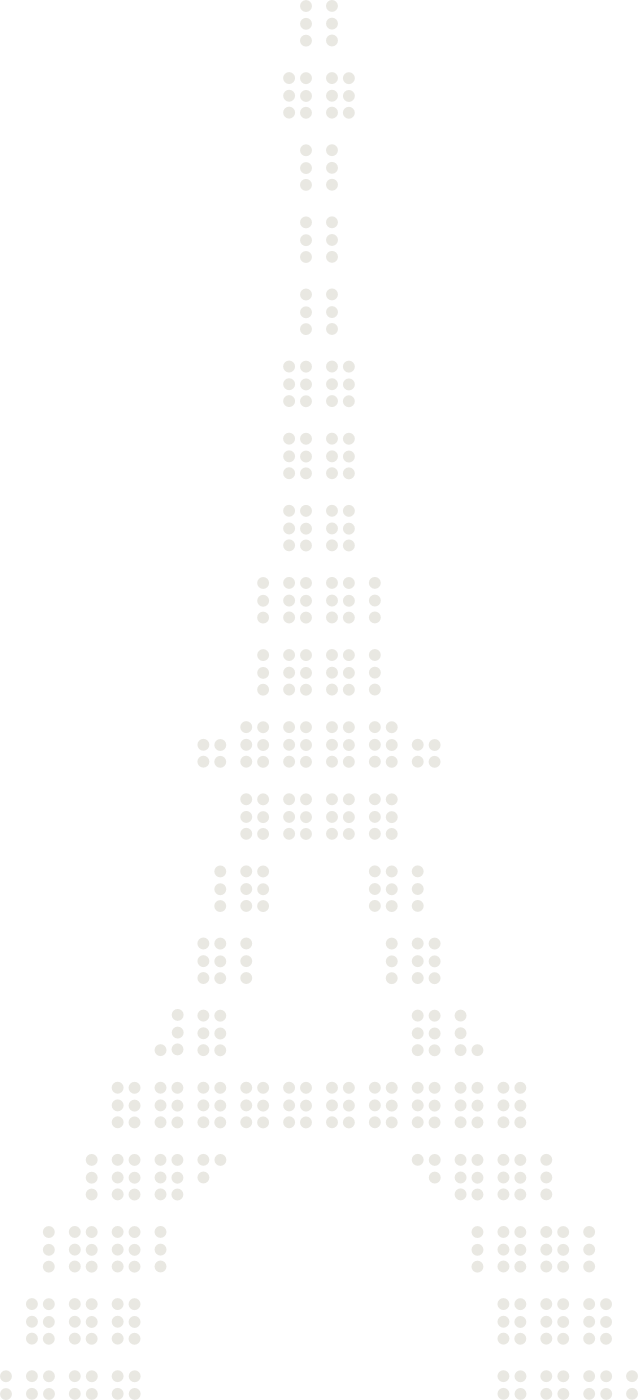
Braille Drawing: Eiffel Tower
Size: 20 rows, 16 cells
By: René Holzhauer (2021)
Here we go!
Row 1:
space 7 times, dots 456, l
Row 2:
space 7 times, FOR 2 times
Rows 3–5:
space 7 times, dots 456, l
Rows 6–8:
space 7 times, FOR 2 times
Rows 9–10:
space 6 times, dots 456, FOR 2 times, l
Row 11:
space 5 times, WERE, FOR 4 times, WERE
Row 12:
space 6 times, FOR 4 times
Row 13:
space 5 times, dots 456, FOR, space 2 times, FOR, l
Row 14:
space 5 times, FOR, l, space 2 times, dots 456, FOR
Row 15:
space 4 times, number sign, FOR, space 4 times, FOR, v
Row 16:
space 3 times, FOR 10 times
Row 17:
space 2 times, dots 456, FOR 2 times, f, space 4 times, d, FOR 2 times, l
Row 18:
space, dots 456, FOR 2 times, l, space 6 times, dots 456, FOR 2 times, l
Row 19:
space, FOR 3 times, space 8 times, FOR 3 times
Row 20:
dots 45, g 3 times, space 8 times, g 3 times, b
Description of the Drawing
Translated by AI: The braille drawing shows one of the four identical sides of the Eiffel Tower. Built of iron, the tower stands at 330 metres and is the tallest structure in Paris. At the very bottom, two of the four massive support pillars can be felt. They form part of the tower’s main struts, which rise upwards in an arched shape. The Eiffel Tower has three levels, which are used as viewing platforms. The first, very large level is situated above the supporting pillars (line 16). The main struts converge after the second level (line 11). The third level is situated below the top (line 2).
This braille drawing was originally created for the non-profit organisation einfach machbar e. V. during the project “Blind Children Draw Pictures – Drawing with Letters” financed by the charity Aktion Mensch.